


 New! Search Engine
 Environ
 Conditions générale de vente
 Confidentialité
 Contact
 Invest
The Joyful Art of Waiting
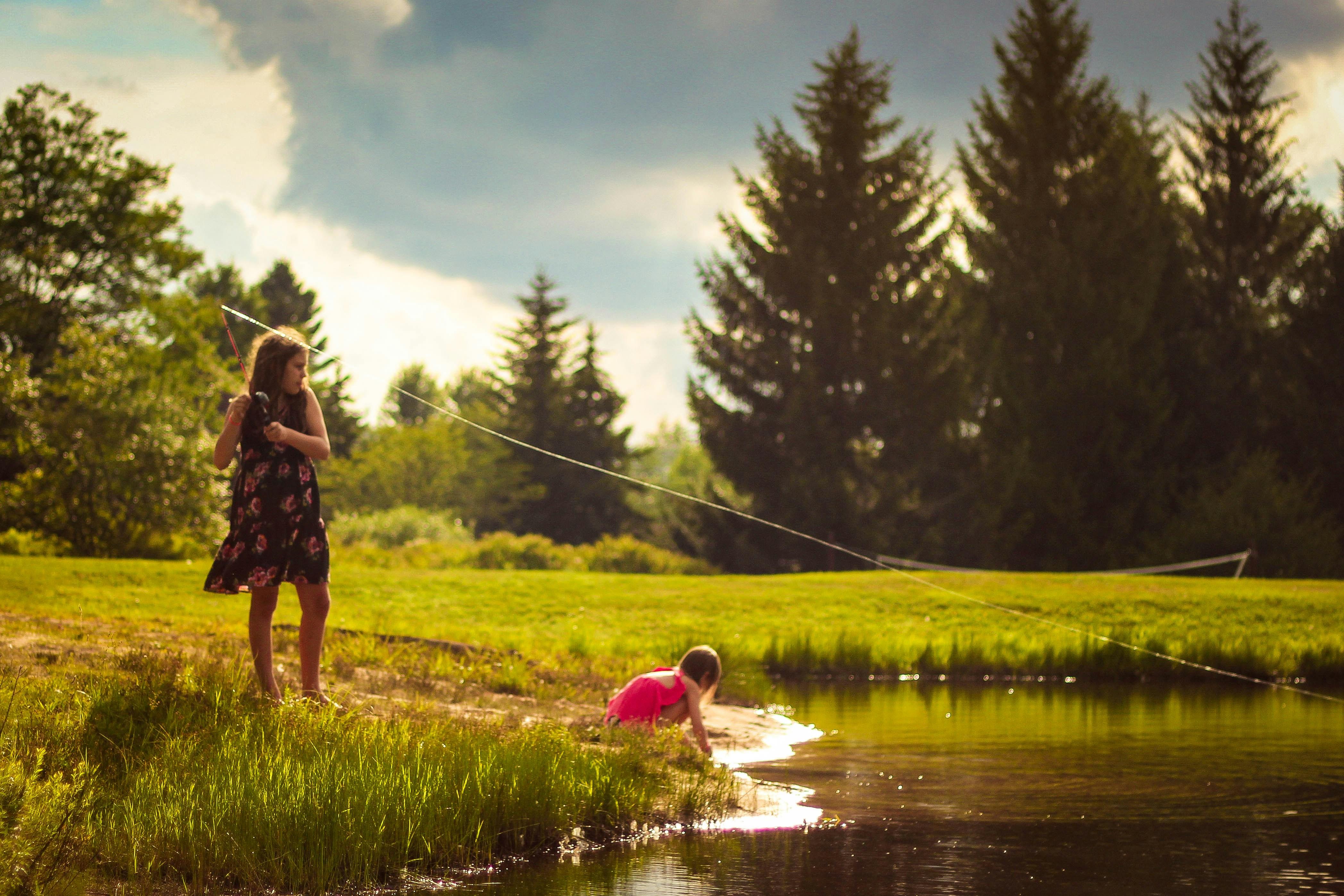
In a serene corner of a sun-dappled field, two children engage in an age-old ritual by the water's edge. One stands poised with a fishing rod, a blend of concentration and excitement illuminating her face, while the other immerses her hands in the cool, flowing water, captivated by nature's treasures. This interplay of patience and curiosity reveals the profundity of biological behavior.
Fishing, often seen as a mere pastime, is steeped in evolutionary significance. The act of waiting, sometimes for hours, carries with it lessons of strategy and survival honed over millennia. Children, in their innocence and instinct, mimic these ancient skills, practicing a form of delayed gratification that is both rare and enriching in today’s instant world. Research suggests that children who engage in such activities develop stronger executive function skills, including self-control and problem-solving, important traits for navigating life's complexities.
Moreover, as one girl holds her line in the still waters, she embodies a fundamental aspect of animal behavior: the predator-prey dynamic. The stillness is not just an absence of motion; it is a calculated strategy akin to how a heron might freeze when hunting. Simplistically put, patience is a virtue, but it is also a biological tactic that optimizes chances of success.
As we observe these young naturalists, it’s worth noting that engaging with nature fosters creativity and can decrease stress levels by as much as 21%. Such statistics remind us of the subtle yet powerful connections we have with our environment, often encapsulated in simple moments like these. In the quiet of waiting, life’s intricate rhythms come alive, unveiling the beauty of patience not just in the pursuit of fish, but in the broader tapestry of existence.
 French
 Thai
Thai
 English
 Spanish
 Portuguese
 Deutsch
 Turkish
 Dutch
Dutch
 Italiano
 Russian